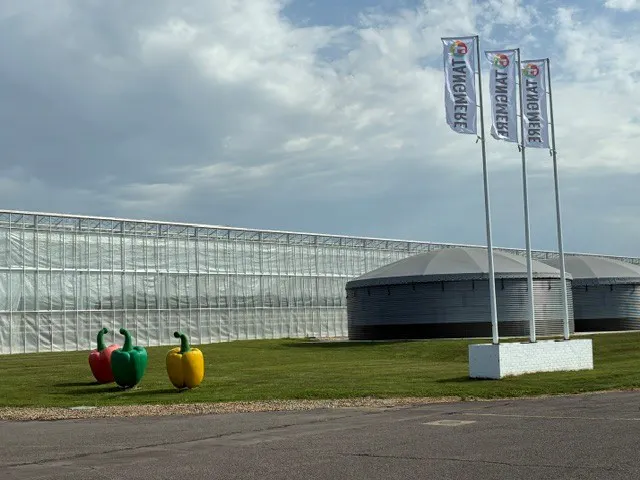
Inspired by the company’s historic location, which played a significant role in the Battle of Britain, Tangmere Airfield Nurseries Ltd is committed to cultivating the best produce with passion and integrity. General Manager Gerard Vonk explains how Grodan supports the UK’s largest dedicated grower of bell peppers in its aim to run a high-quality and sustainable horticultural business.
Having started out growing tomatoes in 3 ha of greenhouses at the airfield just outside the English town of Chichester in 1989, Tangmere Airfield Nurseries switched exclusively to bell peppers in 1994. It has since expanded to around 30 ha. Since 2002, the company has also added 12 ha in Spain to be able to supply its leading UK grocery retail customers year-round.
Responsibility for people and planet
Today, the company produces approximately 68 million bell peppers annually. “We’re the UK’s largest dedicated grower of bell peppers, and that brings a responsibility – to our customers, our employees and our planet,” comments Gerard Vonk. Originally from the Netherlands, he moved to the UK to contribute his horticultural experience to Tangmere in 1988, and has been there ever since.
“Our aim has always been to run a sustainable horticultural business. Our CHP units, double energy screens and solar panels – which in Spain are used to run the air heat pumps – all help to optimise energy use,” he says. Using stone wool growing media from the start has supported this resource-efficient approach by making it much easier to steer the crop. “It gives us precise control over water and nutrition to maximise yield, and allows us to capture, treat and reuse drain water to reduce wastage,” he continues.

A clean start
Stone wool also ensures a clean start for each crop cycle. “It’s crucial to minimise risk because our greenhouses contain over one million pepper plants,” explains Gerard. “With stone wool, we know that no pests or diseases will enter our clean greenhouses via the substrate at the start of each season.”
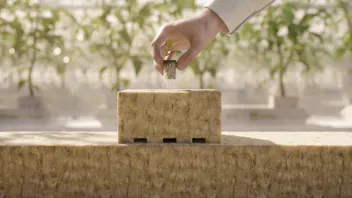
After testing several stone wool suppliers early on, Tangmere selected Grodan and has remained loyal. “The structure of Grodan’s stone wool offers optimal water absorption and retention, and the slabs are very responsive. We exclusively use Grodan slabs in both the UK and Spain, but with a slightly larger slab depth in Spain for better water buffering due to the warmer climate,” he states.
Sensors per valve group
Greenhouse management has become increasingly data-driven in recent years. “Accurate harvest forecasting is vital to fulfil our customer promises. Pepper production is particularly hard to predict because the fruit load fluctuates,” says Gerard.
With four different pepper colours and seven varieties in total, each with specific requirements, this is a tough challenge at Tangmere. “You can’t always tell what a plant needs just by looking at it. GroSens sensors let us see what’s going on in the slab, such as water content percentage, EC and temperature. We have at least one sensor in each valve group so we can measure and monitor each variety, anticipate issues and adjust the irrigation strategy accordingly to keep our production on track,” he explains.
API integration improves decision-making
Decision-making is now even more on point thanks to an API integration between Grodan’s GroSens Suite and Tangmere’s Priva climate computer. “Rather than having to look at multiple dashboards, we now get an immediate, at-a-glance view of how the slab conditions are affected by irrigation and also other climate parameters through Priva Operator – even on our phones,” he adds.
“This gives us valuable insights to make faster, more accurate decisions based on real-time crop data. And we’re already exploring how artificial intelligence could further enhance this,” continues the general manager.
Recycling supports environmental goals
Grodan’s added value also lies in its aftersales support, according to Gerard: “Their service doesn’t stop at supplying stone wool. In line with our environmental goals, we care about sustainable disposal, for instance. Thanks to Grodan’s UK recycling scheme, all our used slabs are now processed locally into granulate for brick-making or soil improvers, for example.”
Furthermore, he appreciates the advice from the company’s specialists. “Stone wool is a fantastic product, but you need to know how to work with it properly, so the aftersales service is almost more important than the product itself. Grodan’s experts provide remote guidance, and visit us at least twice a year. They meet with our production managers, inspect the plants, discuss data and help us refine our crop strategies. We always learn something new,” he comments.
A new chapter for peppers?
Last but certainly not least, Gerard values Grodan’s research efforts. “They share valuable insights and new ideas to support the entire pepper growing industry. For instance, they are investigating the causes of pepper plant wilting to help the whole sector find a solution as quickly as possible,” he states.
Personally, he suspects that today’s pursuit of ever-higher yields may be pushing plants beyond their limits. “Perhaps it’s time to start a new chapter for pepper growing. For now, I’m more than happy with the performance of Grodan’s stone wool, and I see no reason to switch to an alternative substrate,” he concludes.