Designed to grow together

Pepper wilting is a rapid and severe wilting issue observed in high-tech greenhouse pepper crops. Since 2022, affected growers in several regions have been looking for answers on what causes the problem, why symptoms can develop so quickly and how the risk can be reduced.

Grodan has invested in broad international research, together with independent laboratories, research institutes and growers, to better understand the factors that influence pepper wilting. Current findings point to a complex interaction between specific Fusarium isolates, root stress, hygiene practices, irrigation management and chemical exposure in the active root zone.

This page brings together the latest Grodan research insights, practical recommendations and further reading for professional pepper growers.

Author: The Grodan knowledge and communications team

Last updated: March 2026

In short: what growers need to know about pepper wilting

Pepper wilting is linked to a complex interaction between pathogen presence, plant stress and root-zone conditions. Research to date points to specific Fusarium isolates, referred to as FORC in the Netherlands and Belgium, and FOSC in Canada, as important factors in symptom development.

International trials supported by Grodan indicate that oxidising agents such as hydrogen peroxide, when measurable at the dripper or in the active root zone, may increase root stress and amplify wilting expression, especially when Fusarium is present.

For growers, the most important recommendation is clear:

Avoid measurable concentrations of oxidising agents in the active root zone during cultivation.

Good hygiene remains essential, but disinfection practices should be managed in a way that helps protect the crop without directly stressing active roots.

What is pepper wilting?

Pepper wilting is a severe form of wilting in greenhouse pepper crops. Affected plants may lose vigour quickly, show signs of collapse and become difficult to recover. In high-tech greenhouse production, this can create a serious risk to crop performance, yield and grower confidence.

Pepper wilting is not currently understood as a single-factor issue. Current research suggests that symptom expression is influenced by the interaction between pathogen presence, root health, crop stress, hygiene practices and the conditions in and around the active root zone.

What symptoms may growers observe?

Symptoms may vary between crops and regions, but growers commonly report sudden or progressive wilting in pepper plants. In some cases, symptoms can appear rapidly and affect crop uniformity.

Growers should monitor:

  • Sudden wilting
  • Localised symptoms in specific rows, sections or irrigation zones
  • Reduced root health or signs of root stress
  • Changes in drainage behaviour
  • Differences between affected and unaffected crop areas
  • Whether symptoms occur after changes in hygiene, irrigation or water-treatment practices

If symptoms are observed, it is important to document when and where they appear, and to review recent crop-management actions before making corrective changes.

learning, dry sweet pepper, greenhouse, plants, 6-phase model, cultivation period, cultivation phase, grodan

What does current research reveal about the cause?

Current findings point to specific Fusarium isolates as an important factor in pepper wilting. In the Netherlands and Belgium, the isolate is referred to as Fusarium oxysporum radicis capsici, or FORC. In Canada, related isolates are referred to as Fusarium Oxysporum Species Complex, or FOSC.

Research indicates that these isolates can be highly pathogenic and specific to peppers. Initial scientific reports also show that wilting associated with these Fusarium isolates can occur in both stone wool and organic substrates.

However, pathogen presence alone may not explain all differences in symptom expression. Root stress, hygiene practices, irrigation management and the presence of oxidising agents in the active root zone can all influence how severely symptoms develop.

The role of oxidising agents

Oxidising agents, including hydrogen peroxide, are often used as part of hygiene strategies in greenhouse irrigation systems. They can play a role in managing biofilm and maintaining clean irrigation lines.

However, Grodan-supported international research indicates that when measurable concentrations of oxidising agents reach the dripper or active root zone during cultivation, they may increase root vulnerability. Root tissue damage or stress may then increase susceptibility to pathogen pressure and intensify wilting expression.

This does not mean hygiene should be abandoned. It means hygiene practices should be applied in a controlled way, with careful attention to where oxidising agents are active and whether they can reach the active root environment.

Why the active root zone matters

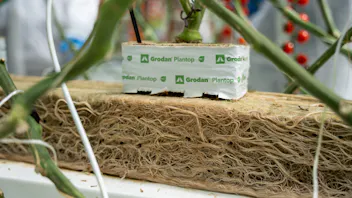
The active root zone is the part of the growing medium where roots take up water, nutrients and oxygen. It is also where the plant interacts with microorganisms in the root-zone microbiome.

A healthy active root zone supports crop resilience. When roots are exposed to additional stress, for example from measurable oxidising agents, poor drainage, oxygen imbalance or other unfavourable conditions, the plant may become more vulnerable to disease pressure.

For this reason, pepper wilting prevention should not only focus on pathogens. It should also focus on maintaining a stable, well-managed and resilient root environment.

Grodan root

Practical do’s and don’ts

Do

  • Maintain strict hygiene during propagation, crop rotation and plant handling.
  • Keep irrigation lines clean, while preventing disinfectants from reaching the active root zone.
  • Use disinfection practices upstream in the irrigation system where possible.
  • Keep drainage clean and flowing.
  • Remove affected plant material promptly and according to hygiene protocols.
  • Monitor EC, pH, water content, drain percentage and root-zone behaviour closely.
  • Contact a Grodan expert, crop consultant or diagnostic laboratory before making major changes to hygiene or irrigation practices.

Avoid

  • Allowing measurable concentrations of oxidising agents to reach the active root zone.
  • Applying peroxide directly into active root systems during cultivation.
  • Over-sanitising in a way that may disturb the root-zone microbiome.
  • Making rapid chemical or irrigation changes without first understanding the likely cause of symptoms.
  • Assuming that substrate type alone explains pepper wilting risk.

What this research does and does not mean

Current findings do not suggest that one single factor explains every case of pepper wilting. Instead, the evidence points to a complex interaction between pathogen presence, root stress, hygiene practices and root-zone conditions.

The recommendation is not to stop hygiene practices. Hygiene remains essential in professional greenhouse production. The recommendation is to manage hygiene in a way that prevents measurable oxidising agents from reaching the active root zone during cultivation.

Every crop situation is different. Growers should assess their own irrigation system, water-treatment strategy, hygiene protocol and disease pressure before making changes.

Stay updated with expert discussions, new findings, and practical explanations directly from our R&D and crop advisory teams. 

Backed by international research collaboration

At Grodan, we value partnerships with growers and experts to identify solutions. Together with external experts, research institutes and scientists, we are conducting multiple trials and are investigating multiple research routes. We are leveraging an extensive network through active collaboration with various pepper growers, organizations, business partners, government bodies, laboratories and independent scientific institutions. The latter are managing several international scientific studies into various possible factors involved in pepper wilting and are simultaneously running trials in Europe and Canada.


Steering crops in high-tech controlled environment agriculture: how stone wool supports unparalleled control over plant development

Steerability is the keyword when it comes to precision growing. But what does steerability mean, exactly? How can growers leverage stone wool growing media and real-time data to gain unparalleled control over plant development? And what are the benefits in terms of yield, quality, resource efficiency and sustainability? In this first whitepaper in our series, Grodan’s Jos Beerens (Senior Crop Technical Specialist) and Marielle Taft (Head of Crop Advice North America) take you on a deep dive into the world of stone wool steerability.

Steering crops in high-tech controlled environment agriculture: actionable strategies to achieve predictable, high-quality results with stone wool

Steerability is the keyword when it comes to precision growing. But how can growers leverage stone wool growing media and real-time data to gain unparalleled control over plant development? And which metrics are most important to monitor? In this second whitepaper in our series, Grodan’s Jos Beerens (Senior Crop Technical Specialist) and Marielle Taft (Head of Crop Advice North America) dive deeper into measuring and steering based on WC%, EC and nutrient supply when using stone wool.

Frequently asked questions

What is pepper wilting?
What causes pepper wilting in greenhouse peppers?
Is pepper wilting caused by Fusarium?
What is FORC?
What is FOSC?
Can hydrogen peroxide increase the risk of pepper wilting?
Should growers use oxidising agents during cultivation?
Can pepper wilting occur in different substrate types?
How can growers reduce the risk of pepper wilting?
How can I contact a Grodan expert?

Contact a Grodan expert

Being an industry leader for decades, we have a lot of in-house expertise. Our people are ready to provide advice and recommendations tailored to your specific situation.

Get in touch with your local Grodan contact for further assistance.

Grodan greenhouse lettuce

Learn more