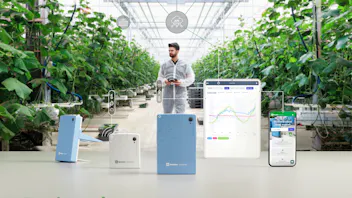
Data-driven growing is becoming increasingly important, including – and perhaps especially – for plant raisers. Dutch firm Brabant Plant has been using the GroSens Suite since 2024, including during the company’s transition from SON-T to 100% LED lighting. Initially, Brabant Plant mainly used the solution in propagation research, and subsequently to continuously optimise crop strategies without jeopardising the tight production schedules. Since then, Crop Researcher Marvin Verkuijlen has noticed that his production colleagues keep finding practical applications for the sensors in their day-to-day work.
Established in 1969, the Dutch family-run firm Brabant Plant is specialised in the propagation of various greenhouse vegetables, such as tomatoes, cucumbers, peppers and aubergines, as well as open-field vegetables, flowering pot plants, and cuttings and propagation material for the floriculture sector. The translates into a huge number of product groups. According to Crop Researcher Marvin Verkuijlen, in tomato alone the company has worked with around 200 different varieties. “And new varieties are constantly being introduced to replace the old ones. This diversity leads to a growing number of batch-specific variations. In addition, due to the different growth phases of tomatoes, an enormous amount happens from a plant physiology perspective within a short space of time. So for me, it’s like one big research ‘playground’ here,” he says.
Production schedule is set in stone
“Our customers are constantly on the lookout for new varieties, so we do a lot of trials together with them. We’re also continuously analysing and improving our existing processes. But changing something can affect the entire production schedule. For example, if the plants haven’t rooted in properly and we can’t pinch them during the potting phase, then it delays everything else. But our schedule is set in stone, because we have strict deadlines in the final phase.”
At Brabant Plant, they sometimes graft up to 200,000 plants a day in tomato alone. “We have to optimally manage each plant physiologically and morphologically so that it develops into the desired end product properly – with strong roots and the first trusses ready for flowering – by the agreed delivery date. Therefore, we have to control the temperature, irrigation and light level very precisely to achieve the desired vegetative or generative steering.” This is something Marvin knows a lot about thanks to his many years as a researcher.
Real-time insight
“What’s more, our plants are shipped before they are fully grown, so we lack a lot of information – such as stem thickness and head size – that commercial growers use as indicators,” Marvin continues. “Often, we can’t even use scales to weigh the water uptake.”

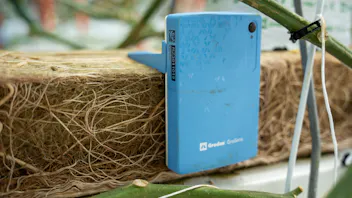
To gain as much real-time insight as possible into what is happening to – or even inside – the plants as input for the crop strategies, the company has installed various sensors, including Grodan’s GroSens Suite. Marvin: “The sensor data is also fed into our Priva climate computer and provides a valuable addition to the daily graphs and our overall understanding.”
Complex operation
Brabant Plant currently has 12 hectares of greenhouses, divided into 27 sections, each with a separately controllable climate and around ten different irrigation zones. In other words, it is a highly complex operation. “If we wanted to install three sensors per zone – and even that’s on the low side – we would need dozens of sensors,” says the crop researcher. According to him, some growers are put off by this. “But we’ve only purchased eight GroSens Suite sensors and that works fine. They really don’t need to be everywhere. It’s all about how you use them.”
Revealing fluctuations
As an example, he mentions monitoring the water levels in the ebb-and-flow system: “By placing four sensors at different points within an irrigation zone – such as in the centre and along the edges – we can check whether the water is spreading evenly.” In addition, Brabant Plant uses multiple sensors to monitor uniformity over time. “This can sometimes reveal interesting fluctuations, in which case we look for the root cause. The data provides a very useful basis for formulating research questions and testing hypotheses.”
Sometimes they select a popular or problematic variety and then track an entire production batch in real time through the various phases – from sowing to final spacing. “By combining these measurements with other data sources, we get a clear overall picture of which parameters matter, what has happened to the plant, why it has happened and what we can do differently,” adds Marvin.
Transition to 100% LED
Grodans’ GroSens Suite recently proved particularly useful during Brabant Plant’s full transition to dynamic LED lighting. Marvin was heavily involved in the project. “We had used SON-T lamps for around 35 years. When we decided to replace them all, we knew the reduction in radiant heat and the impact on the microclimate meant we would have to rethink our entire crop schedule. We already had lots of data, but we needed a better understanding of evaporation.”
They first began taking measurements whilst still using the SON-T lamps, and continued with the same measurements in the LED setup. “We could simply place the GroSens sensor on the floor and leave it there during the waterings. The insights into the differences – the effect on EC, root zone temperature, water uptake and plant activity – really helped us to validate our schedule adjustments and futureproof our company with this innovation,” comments Marvin.
Shift towards day-to-day tasks
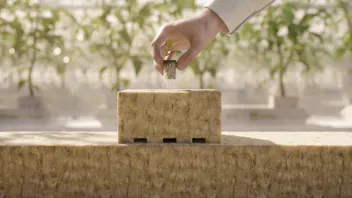
Although the GroSens Suite has so far been used mainly at a strategic level, Marvin sees a steady shift towards its use in day-to-day tasks. “My colleagues are increasingly taking the Grodan sensors with them to the various production departments as handheld devices. This allows them to take on-the-spot readings of things like the water content percentage in the substrate, for example, and also to check that there are no leaks in the rubber seals around the irrigation zones.”
Marvin also sees the value of these handheld tools in the context of the horticulture sector’s ageing workforce. “One of our older growers was so naturally ‘calibrated’ that he could tell exactly how much water was in a substrate simply by feeling it. But he’s now retired, so we’re missing some of that knowledge and experience. A sensor like this can be a big help for the younger generation. It doesn’t replace a grower’s ‘green fingers’, but it gives us a useful indication of how our actions influence what’s actually happening at plant level.”

Data quality
Needless to say, as a researcher, Marvin always pays close attention to data quality. “We regularly check how much water is actually in a block for calibration purposes, and I’m very pleased with the accuracy of the Grodan sensors. We tested sensors from various suppliers before deciding what to purchase – and it’s no coincidence that we ultimately opted for the GroSens Suite. Plus it speaks volumes that Grodan has set up a dedicated department to actively support both the technology and the users. What’s more, the sensors are fine-tuned to the specific characteristics of the Grodan blocks.”
A key piece of the puzzle
“Getting a plant off to the best possible start is like doing a jigsaw puzzle. The GroSens Suite is a key piece of that puzzle that links many other pieces together, allowing you to monitor various aspects of your crop strategy and sometimes uncovering unexpected trends. This solution can still help us learn and improve many things, in both the short and long term,” concludes Marvin.
Keen to know more?
Are you curious about how GroSens can support your propagation activities? Contact your Grodan advisor for a demonstration or tailored advice.